Interventional Cardiology is one of the most rapidly evolving branches of medicine, continuously introducing newer and cutting-edge technologies at regular intervals. For an interventional cardiologist, staying updated with these advancements and developing the technical expertise required to safely adopt and execute such procedures is essential for delivering the best possible patient care.
One such advanced plaque-modification technology is Orbital atherectomy, a specialized procedure used for the treatment of severely calcified coronary artery lesions. This technology represents an important advancement in complex coronary intervention, especially in lesions where conventional angioplasty techniques may fail to achieve adequate vessel preparation.
The first orbital atherectomy procedure in India was performed by Samim Sharma from Mount Sinai Health System in Jaipur in February 2023. It marked the introduction of this sophisticated calcium-modification modality into Indian interventional practice.
Building on this advancement, Dr. Dhananjay Kumar performed the first orbital atherectomy procedure in Bihar and Jharkhand in 2024. This milestone reflected his commitment to early adoption of emerging interventional technologies and his constant pursuit of expanding therapeutic options for complex coronary artery disease. The inaugural case was successfully performed in an octogenarian patient, demonstrating both procedural expertise and confidence in applying advanced technology even in high-risk elderly patients.
Following this landmark case, he has been routinely performing orbital atherectomy procedures for complex calcified coronary lesions, integrating this technology into regular clinical practice for carefully selected patients.
Recognizing his expertise and growing experience, since 2025 he has been selected as a proctor for orbital atherectomy by Abbott, the USA-based manufacturer of this technology. As a proctor, his role involves training fellow cardiologists in the technical aspects, procedural nuances, and safe execution of orbital atherectomy. Till now, he has trained multiple interventional cardiologists and has performed numerous cases at various centers, contributing significantly to the wider dissemination of this advanced coronary intervention technique.
His journey with orbital atherectomy reflects not merely procedural adoption, but a larger commitment to academic growth, technological leadership, and the advancement of contemporary interventional cardiology practice in eastern India.
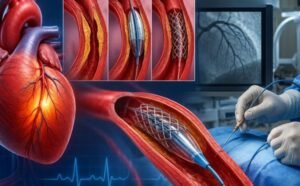
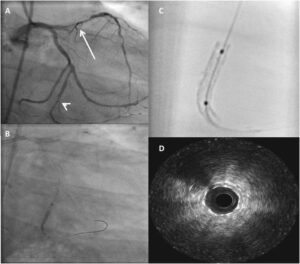
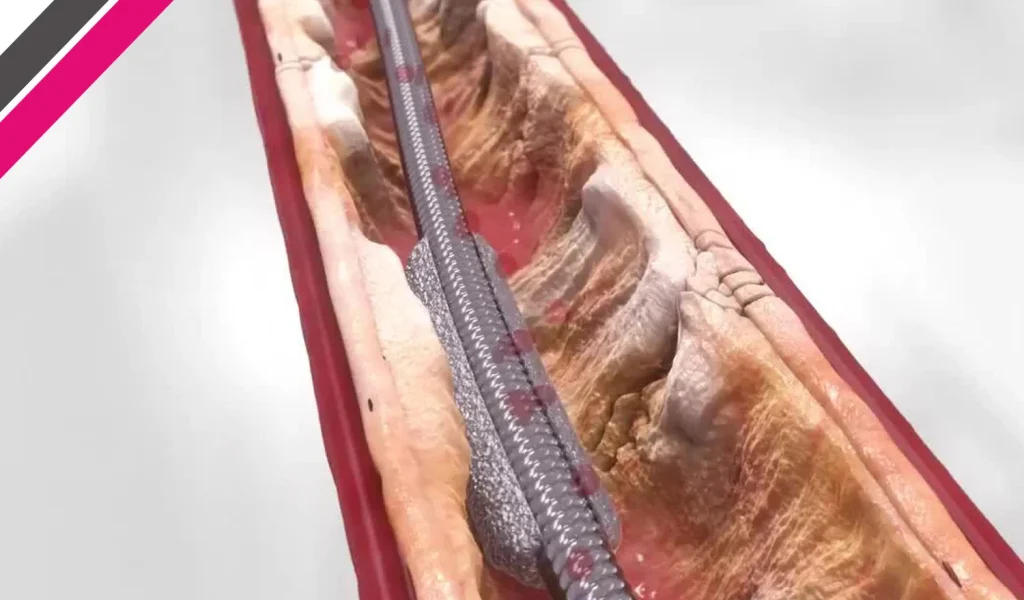
Orbital atherectomy is an advanced plaque-modification technique used during complex coronary angioplasty for treating severely calcified coronary artery lesions. These are lesions where conventional balloon angioplasty often fails because the calcium makes the vessel rigid and resistant to expansion. Proper calcium modification is essential in such cases to ensure adequate lesion preparation and optimal stent expansion.
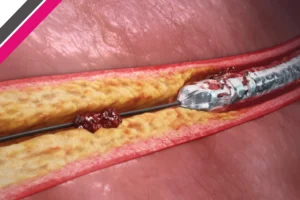
The technique works through a diamond-coated crown mounted on a specialized guidewire. This crown rotates at very high speed and moves in an orbital, eccentric path within the artery. As it spins, it sands away superficial calcium deposits while preserving the relatively elastic normal vessel wall. This process increases vessel compliance, making subsequent balloon dilatation and stent deployment easier and more effective.
Orbital atherectomy differs significantly from rotational atherectomy. In rotational atherectomy, the burr rotates concentrically and creates a lumen limited by the burr size, often requiring a step-up burr strategy for larger vessels. In contrast, orbital atherectomy uses a single crown that creates a progressively larger sanding orbit as rotational speed increases, allowing treatment of vessels of different diameters. Another practical advantage is that it permits better continuous antegrade blood flow during runs, potentially reducing ischemia.
Its major indications include severe concentric coronary calcification, balloon-undilatable lesions, heavily calcified left main disease, bifurcation lesions with extensive calcium, and other complex PCI situations where inadequate lesion preparation could result in underexpanded stents. In these scenarios, proper plaque modification significantly improves procedural success and long-term outcomes.
The major advantages of orbital atherectomy include effective treatment of diffuse calcific disease, improved lesion compliance, reduced need for multiple crown sizes, and its usefulness in long calcified segments. It is especially valuable in lesions where conventional balloons fail to achieve adequate expansion.
However, the technique requires operator experience and careful case selection. Potential complications include slow-flow or no-reflow, coronary dissection, perforation, vessel spasm, distal embolization, and transient bradyarrhythmias, especially during right coronary artery interventions. Cost and limited availability also restrict its routine use in many centers, particularly in resource-constrained settings.
Compared with other calcium-modification strategies, orbital atherectomy has distinct strengths. Rotational atherectomy is often favored for focal, very tight, wire-crossable nodular calcium, while orbital atherectomy may be preferred for diffuse circumferential calcification. More recently, Shockwave Intravascular Lithotripsy has emerged as an important alternative, using sonic pressure waves to fracture deep calcium. While intravascular lithotripsy is simpler to use and increasingly popular, orbital atherectomy remains particularly valuable in very tight lesions where an IVL balloon cannot cross.
In experienced hands, orbital atherectomy is a highly effective tool for calcium modification in complex PCI. Its central principle reflects a fundamental concept in interventional cardiology: adequate lesion preparation must always precede stent implantation, because durable outcomes depend on optimal scaffold expansion.